


Your spellchecker just underlined a word you were sure was right. Was it organizing or organising. Relax, both are correct.
In organizing vs organising, the only difference is region: organizing is American, and organising is British. Pick the one that fits your reader and stay consistent.
Why Two Spellings Exist
The word traces back to the Greek organon, meaning “tool” or “instrument.” It passed through Latin and Medieval Latin, then Old French, before reaching English around the 1400s.
Along the way, the ending took two forms: -ize, which follows the Greek root, and -ise, which follows the French route.For centuries, English writers used both without much fuss.
In the early 1800s, Noah Webster pushed American spelling toward simpler, more phonetic forms, and -ize became the American standard.
British publishers gradually favored -ise, partly because it matched French and partly because it was easier to apply to every verb ending in that sound.
Organizing vs Organising at a Glance
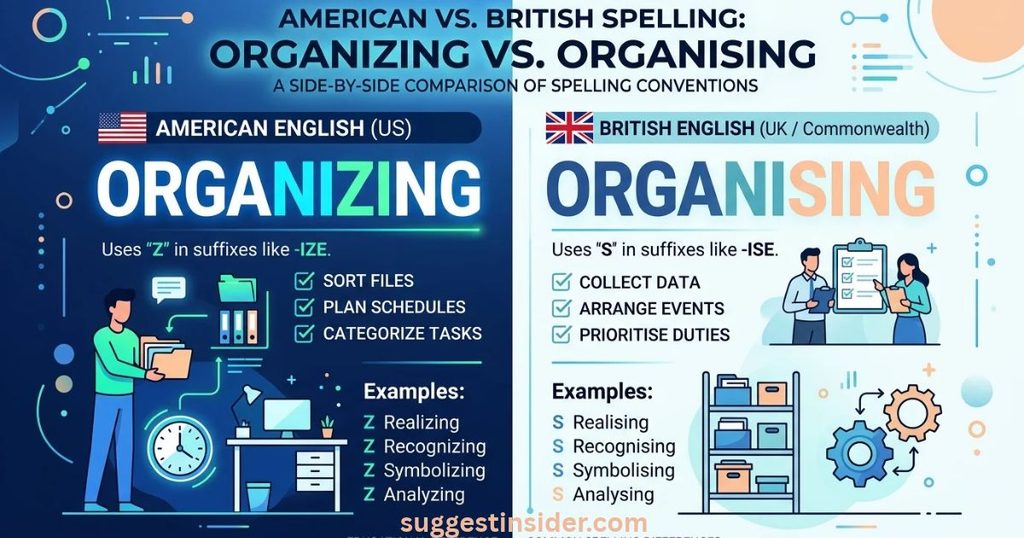
| Feature | Organizing | Organising |
| Main region | United States, Canada | United Kingdom, Australia, New Zealand |
| Verb ending | -ize | -ise |
| Meaning | Arranging or coordinating | Arranging or coordinating |
| Pronunciation | Same | Same |
| Past tense | Organized | Organised |
| Noun for a person | Organizer | Organiser |
| Noun for a group or system | Organization | Organisation |
| Accepted in formal writing | Yes | Yes |
The only thing that changes is one letter. The sound, the grammar, and the definition all stay put.
Which Countries Use Which Spelling
Here is a practical map of where each version shows up:
- United States: organizing, with no real exceptions.
- Canada: usually organizing. Canadian English mixes American -ize with British touches like colour.
- United Kingdom: organising is the everyday choice in newspapers, schools, and business writing.
- Australia and New Zealand: organising is standard.
- Ireland and South Africa: organising is generally preferred.
- India: both appear, though many publications lean toward organising.
The Oxford Spelling Twist
Here is a detail most guides skip. Some British publishers, including Oxford University Press, use -ize in words like organize and recognize while keeping British spellings elsewhere, such as colour and centre.
This is called Oxford spelling. If you see “organizing” in a British academic book, it is not an American slip. It is a deliberate house style.
Do They Mean the Same Thing?
Yes. Organizing and organising share the same definitions and can be swapped without changing a single idea.
As a verb, the word means to arrange things in a systematic order, or to plan and coordinate an event or effort. “She is organizing the files” and “She is organising the files” describe the same action.
As a noun, the -ing form usually names the activity itself. “Community organizing” describes people working together to push for change. “Event organising” describes the planning of gatherings.
Context is what sharpens the meaning, not the spelling. You can organize a closet, a wedding, a union, or your thoughts. The “-ize or -ise” question never affects which of those you mean.
Which Spelling Should You Use?
Ask yourself one question: who is reading this?
- Writing for a US audience: use organizing.
- Writing for a UK, Australian, or New Zealand audience: use organising.
- Writing for a global audience: pick one style and apply it everywhere.
- Submitting to a school, journal, or publisher: follow their style guide.
- Writing for yourself: use whichever your brain prefers.
When two choices are both correct, consistency is what readers notice. A page that says “organizing” in paragraph one and “organising” in paragraph four looks careless, even though each spelling is valid.
If your readers come from several countries, go with the spelling used where most of them live. Your website analytics or email list can usually tell you.
Related Word Forms
The spelling split extends to every relative of the word. If you choose one style, the rest of the family follows.
| American | British |
| organize | organise |
| organizes | organises |
| organized | organised |
| organizing | organising |
| organizer | organiser |
| organization | organisation |
| organizational | organisational |
| reorganize | reorganise |
| disorganized | disorganised |
A quick tip: if the American form has a z, the British form swaps it for an s. That one rule covers the entire list.
Example Sentences in Both Spellings
Seeing the words in real sentences helps the pattern stick.
American English
- “I spent Saturday organizing the garage, and I found three missing screwdrivers.”
- “Our organization is organizing a food drive next month.”
- “She is a professional organizer who helps people declutter.”
British English
- “I spent Saturday organising the garage, and I found three missing screwdrivers.”
- “Our organisation is organising a food drive next month.”
- “She is a professional organiser who helps people declutter.”
Everyday uses
- “Organizing your inbox into folders saves time.” (US)
- “Organising a surprise party takes more planning than it looks.” (UK)
- “The union spent months organizing workers across the state.” (US)
- “He is good at organising people and keeping them calm.” (UK)
Common Mistakes and Quick Fixes
Most errors come from mixing the two styles. Here are the ones that appear most often.
- Mixing spellings in one document. Writing “organizing” in one place and “organisation” in another is the top mistake. Fix it by choosing one style before you start.
- Assuming one spelling is wrong. Neither is an error. A spellchecker flags the one that does not match its language setting, not a real mistake.
- Changing a proper name. Official names keep their original spelling. The “International Organization for Standardization” is spelled with a z, even in British writing. The same goes for names like “World Health Organization.”
- Dropping the e incorrectly. The correct forms are organize to organizing, not “organizeing.” The silent e drops before -ing.
- Mixing noun and verb forms. Organization is a noun, and organize is a verb. Writing “We need to organization the files” is a grammar slip, not a spelling one.
How to Keep Your Spelling Consistent
A few small habits prevent most problems:
- Set your language. In Word, Google Docs, and most editors, choose English (US) or English (UK) before you write. The spellchecker will then catch mismatches for you.
- Use find and replace. Search for “ize” and “ise” at the end of drafting to spot stragglers. Review each match, since some words need -ise in both styles.
- Follow a style guide. Many companies and publishers specify a standard. When one exists, use it.
- Check names last. Review company names, titles, and quoted material so you do not “correct” a proper name by accident.
Other Words That Follow the Same Pattern
The organize and organise split is part of a much larger group. Many verbs switch between -ize and -ise depending on the region:
- recognize / recognise
- realize / realise
- apologize / apologise
- prioritize / prioritise
- summarize / summarise
- criticize / criticise
There is a handy exception worth knowing. Some words end in -ise in both American and British English because the ending is part of the word’s root rather than a verb suffix.
Examples include advertise, revise, exercise, surprise, compromise, and supervise. Writing “advertize” is a mistake in every country.
Frequently Asked Questions
Is organizing or organising correct?
Both are correct. Organizing is the standard in American and Canadian English, while organising is standard in British, Australian, and New Zealand English.
Is organising wrong in American English?
Most American editors and spellcheckers treat organising as a British variant, so it will usually be flagged or changed in US publications.
Do organizing and organising sound different?
No. They are pronounced the same way in both countries. The difference exists only on the page, so you will never hear it in conversation.
Is organization spelled with a z or an s?
It depends on your region. Americans write organization, and most British writers use organisation.
Which spelling is better for international readers?
Neither is better. Pick the version your largest audience uses and stay consistent throughout. If your readers are evenly split, either works as long as you do not switch midway.
Conclusion
The organizing vs organising debate has a simple answer. They are the same word with two accepted spellings, one favored in the United States and Canada, the other across most of the British Commonwealth.
Choose the one that suits your readers, set your editor’s language to match, and apply it to every related word, from organizer to organisation.

Noah Daniel Davis is a passionate grammar and language writer who creates simple, helpful content about grammar, vocabulary, punctuation, and English writing. His goal is to make language learning easy and practical for every reader.