


You are typing a quick text, a work email, or a birthday card, and your fingers freeze. One m or two? One r or two? The Tomorrow vs Tommorow question trips up confident writers every single day, and one wrong letter can make a polished message look rushed.
Worse, spell check does not always rescue you. The good news is that the correct spelling follows a simple pattern, and once you see it, you will stop second-guessing yourself for good.
How Do You Spell Tomorrow?
The correct spelling is T-O-M-O-R-R-O-W. That is eight letters in total.
Here is the letter count at a glance:
- M: one
- R: two (side by side, in the middle of the second half)
- O: three
- T and W: one each
Break it into three chunks and it gets easier: to + mor + row. The double r sits right where “mor” meets “row.”
Why Tommorow Is Wrong (and Why So Many People Write It)
“Tommorow” puts the double letter in the wrong place. It doubles the m and gives the word only one r. Standard dictionaries do not list it as a variant, regional spelling, or alternate form. It is simply an error.
So why does it happen? A few reasons stand out:
- Familiar patterns. Words like “common,” “summer,” and “committee” have a double m, so the brain expects one here too.
- The name Tom. Many people hear “Tom” at the start and write it that way.
- Sound. When you say the word aloud, you cannot hear which letter is doubled. English spelling often hides double letters from your ears.
- Speed. Fast typing and phone autocorrect habits make small slips feel normal.
The double letter is real, but it belongs to the r, not the m.
Common Misspellings of Tomorrow
If you have ever written one of these, you are in good company. Here is how the most frequent errors compare with the right form.
| Incorrect spelling | What went wrong | Correct spelling |
| Tommorow | Doubled the m, only one r | Tomorrow |
| Tommorrow | Doubled the m, and also doubled the r | Tomorrow |
| Tomorow | Only one r | Tomorrow |
| Tomarrow | Replaced the second o with an a | Tomorrow |
| Tommarow | Doubled the m and swapped o for a | Tomorrow |
| Tomoro | Dropped letters, often from texting | Tomorrow |
Notice the pattern. Nearly every error comes from moving, adding, or deleting a double letter. The fix is always the same: one m, two r’s.
Easy Ways to Remember the Double R
Memory tricks work best when they are short and a little silly. Try one of these:
- Say it in chunks. Read it as “to-mor-row” and picture the two r’s holding hands in the middle.
- Link it to “morrow.” The old word “morrow” has two r’s, and “to” is just stuck on the front.
- Count the letters. Eight letters, one m, two r’s. Say “one m, two r’s” a few times and it sticks.
- Use a sentence. “Tomorrow, I will remember the rows.” The word “rows” hints at the double r in “row.”
- Write it five times. Boring, but the hand often remembers better than the head.
Pick the one that feels natural. You only need one.
Where Does the Word Tomorrow Come From?
The spelling makes more sense once you know the history. “Tomorrow” began as a phrase in Old English meaning roughly “on the morning.” Over time, “morrow” came to mean the next day, and “to” joined it as a prefix.
That history explains the double r. The core of the word is morrow, which already had two r’s. When “to” was added, nothing about those letters changed.
Earlier writers often wrote the word as to-morrow with a hyphen, or even as two words. Spelling was far less fixed in earlier centuries, and the single-word form became standard over time.
If you want to see the old style in action, read Shakespeare. In Macbeth, the famous speech repeats “tomorrow” three times in a row, and the word’s rhythm is part of the point.
Is “To Morrow” Ever Correct?
Not in modern writing. “To morrow” and “to-morrow” are old-fashioned forms you may spot in historical books, older letters, or period fiction. Today, standard English uses the one-word spelling tomorrow.
There is one small exception worth knowing. The word “morrow” still exists on its own, mostly in poetic or formal settings, as in “on the morrow.” But that is a different usage, not a spelling variant of tomorrow.
If you are writing an email, a school paper, a résumé, or a text, stick with tomorrow.
Tomorrow as an Adverb and as a Noun
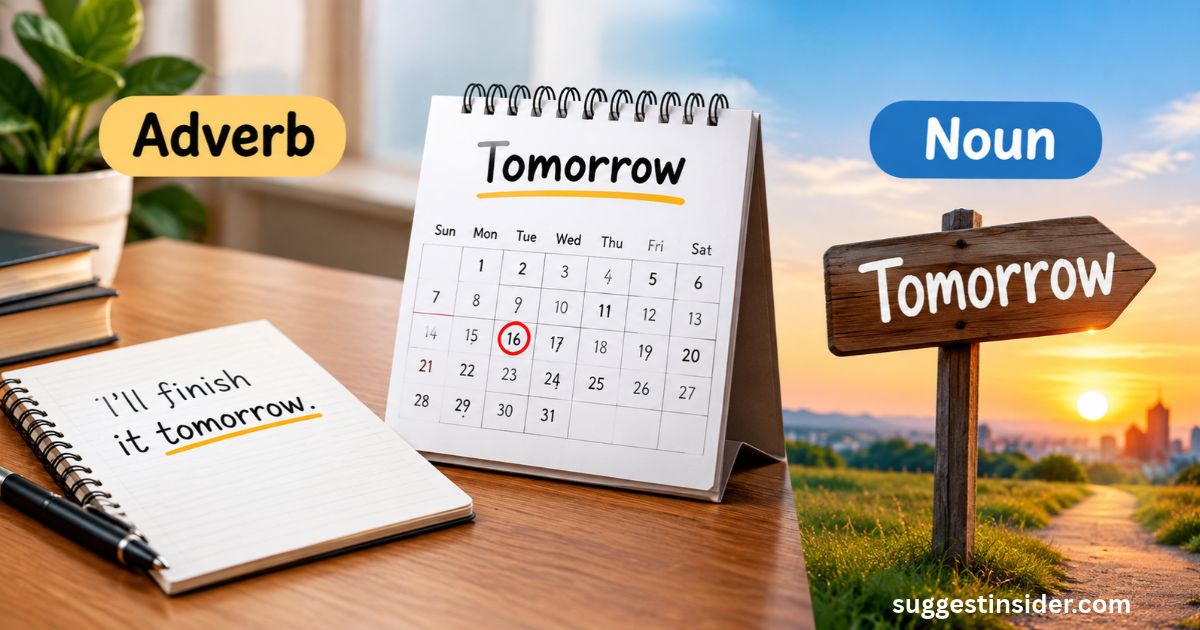
Tomorrow does two jobs in a sentence, and the spelling stays the same either way.
As an adverb, it tells you when something happens:
- I will call you tomorrow.
- The package arrives tomorrow morning.
As a noun, it names the next day or a future time in general:
- Tomorrow is going to be busy.
- She spends too much time worrying about tomorrow.
- Young people are the leaders of tomorrow.
A quick test: if you can replace the word with “the next day” and the sentence still works, you are probably using it right.
Tomorrow’s vs Tomorrows: Which One Do You Need?
This pair causes a second round of confusion. The difference is just an apostrophe, but the meaning changes.
| Form | Use | Example |
| Tomorrow’s | Possessive, something that belongs to tomorrow | Tomorrow’s meeting starts at nine. |
| Tomorrows | Plural noun, more than one tomorrow | We all have our tomorrows to plan for. |
Most of the time, you want tomorrow’s. Think of “tomorrow’s weather,” “tomorrow’s lunch,” or “tomorrow’s deadline.” The plural “tomorrows” is rare and shows up mostly in reflective or poetic writing.
What about “tomorrows'”? That form is almost never needed. It would show possession by multiple tomorrows, and you can nearly always rewrite the sentence more simply.
Incorrect vs Correct Sentences
Seeing the fix in a full sentence helps it stick. Here are real-life examples you might write this week.
Everyday messages
- ❌ I’ll see you tommorow at the gym.
- ✅ I’ll see you tomorrow at the gym.
Work emails
- ❌ Please send the report by tommorrow afternoon.
- ✅ Please send the report by tomorrow afternoon.
Texting
- ❌ cant wait for tomarrow!
- ✅ Can’t wait for tomorrow!
School and formal writing
- ❌ Tomorows exam will cover chapters one through five.
- ✅ Tomorrow’s exam will cover chapters one through five.
A date is sometimes better
In schedules, contracts, and anything people may read days later, “tomorrow” can become confusing. If someone opens your email on Friday, “tomorrow” means Saturday, not the day you meant. In those cases, write the actual date: “The deadline is Thursday, March 12.”
Capitalization, Pronunciation, and Texting
A few small details are worth getting right.
Capitalization. Tomorrow is not a proper noun, so do not capitalize it unless it starts a sentence or appears in a title. “I’ll finish tomorrow.” Not “I’ll finish Tomorrow.”
Pronunciation. In American English, most people say “tuh-MAR-oh” or “tuh-MOR-oh.” Both are fine. The stress falls on the second syllable.
Texting. Shortcuts like “tmrw” or “2morrow” are common in casual messages. They are fine between friends, but save the full spelling for work, school, and anything formal.
Spell check. Autocorrect usually fixes “tommorow,” but it is not perfect. If you type “to morrow” as two separate real words, many tools will not flag it. A quick read-through before you hit send is still your best backup.
Other Words With the Same Double-Letter Trap
If doubled letters keep tripping you up, you are not alone. Here are other words where the doubled letter hides from your ears:
| Word | The tricky part |
| Accommodate | Two c’s and two m’s |
| Embarrass | Two r’s and two s’s |
| Occurrence | Two c’s and two r’s |
| Recommend | One c, two m’s |
| Necessary | One c, two s’s |
| Committee | Two m’s, two t’s, two e’s |
| Address | Two d’s and two s’s |
The habit that helps most is the same one you used for tomorrow: split the word into chunks and note exactly where the doubles sit.
Frequently Asked Questions
Is tommorow ever correct?
No. “Tommorow” is not a valid spelling in standard American or British English. The correct form is tomorrow, with one m and two r’s.
How many m’s and r’s are in tomorrow?
Tomorrow has one m and two r’s. The double r comes from the old root word “morrow.”
Is tomorrow capitalized?
Only when it begins a sentence or appears in a title. In the middle of a sentence, write it in lowercase: “We leave tomorrow.”
What is the difference between tomorrow’s and tomorrows?
Tomorrow’s shows possession, as in “tomorrow’s schedule.” Tomorrows is a plural noun meaning more than one tomorrow, and you will rarely need it.
Conclusion
The Tomorrow vs Tommorow debate has a clear winner. Tomorrow is correct, with one m and two r’s, and “tommorow” is simply a misspelling that looks right until you slow down.
Remember the chunks (to + mor + row), remember that the double r comes from “morrow,” and double-check any message that matters. Do that, and you can write “see you tomorrow” with full confidence.

Noah Daniel Davis is a passionate grammar and language writer who creates simple, helpful content about grammar, vocabulary, punctuation, and English writing. His goal is to make language learning easy and practical for every reader.