


You are typing a caption, a bio, or a spa menu, and your spell-checker stays silent. Both versions look fine, so which one do you pick? Guess wrong and a polished page suddenly looks careless.
The confusion around aesthetic vs esthetic is common because both spellings exist in American English, and both appear in print.
The good news is that the choice is simpler than it looks. Once you know which word fits which situation, you will never second-guess it again.
What Do Aesthetic and Esthetic Actually Mean?
Both words come from the same root and carry the same core meaning. They describe things connected to beauty, artistic taste, or how something looks and feels to the senses.
Here are the main meanings you will run into:
- Relating to beauty or art: “The museum has a strong aesthetic appeal.”
- Pleasing in appearance: “She chose the lamp for aesthetic reasons, not practical ones.”
- A particular visual style (noun): “The film has a retro aesthetic.”
- Appreciating beauty (adjective): “He has a refined aesthetic sense.”
Esthetic covers the same ground. There is no hidden difference in definition. The only real difference is how common each spelling is and where you will see it.
Which Spelling Is Correct in the US and UK?
Both are accepted in American English, but they are not equal in popularity. Major US dictionaries list aesthetic as the main entry and treat esthetic as a variant. In British English, aesthetic is the norm, and esthetic looks unusual.
A quick way to think about it:
- Writing for a general audience: use aesthetic.
- Writing for any international audience: use aesthetic.
- Following an industry style, such as US cosmetology licensing: you may see esthetic, so match the field.
Many people assume esthetic is simply the “American spelling,” the way color is the American spelling of colour. That is only partly true. American English did drop the “ae” in words like anesthesia and pediatrics.
But with aesthetic, the “ae” version stayed dominant in the US, probably because the word is tied so closely to art, philosophy, and design, where the traditional spelling held on.
Where Did the Two Spellings Come From?
The word has a short but interesting history. It traces back to the Greek aisthetikos, which means “perceptive,” from a verb meaning “to perceive.”
In the 1700s, German philosopher Alexander Baumgarten used the Latin term aesthetica for the study of sensory knowledge and beauty. Immanuel Kant later helped spread the idea in philosophy.
The word then moved into English in the late 1700s.Early English writers kept the Latin-style “ae,” which was written as a joined letter in many printed works.
Over time, American writers simplified many “ae” and “oe” words, following the spelling reforms associated with Noah Webster. That is how esthetic appeared as a variant. It simply never fully replaced the original.
Aesthetic vs Esthetic at a Glance
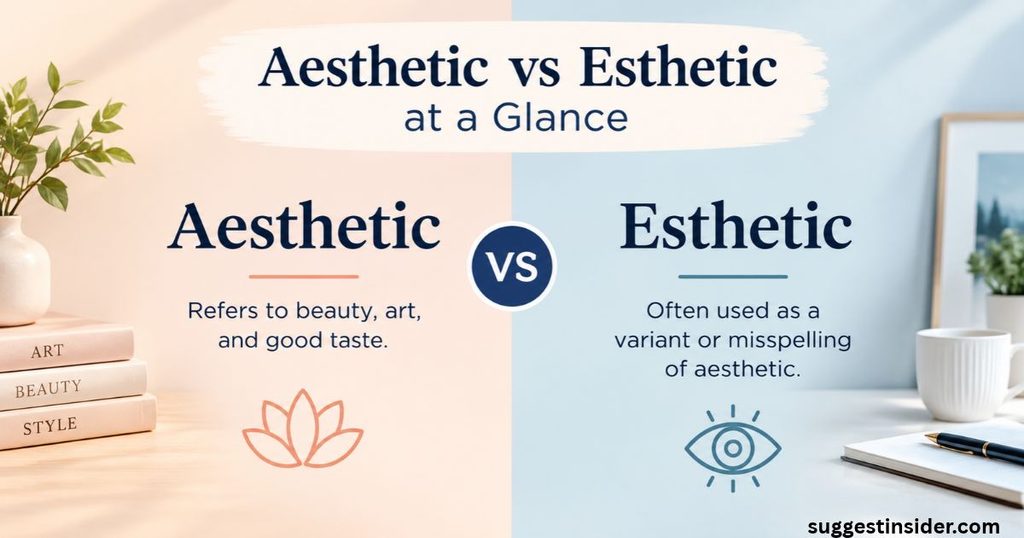
| Feature | Aesthetic | Esthetic |
| Meaning | Relating to beauty and artistic taste | Same meaning |
| Status | Standard, preferred spelling | Accepted variant |
| US usage | Very common | Less common, field specific |
| UK usage | Standard | Rare |
| Noun form | aesthetic, aesthetics | esthetic, esthetics |
| Adverb | aesthetically | esthetically |
| Common in | Art, design, philosophy, fashion, social media | Skin care licensing, some dental and medical terms |
| Safe for any audience? | Yes | Not always |
When Is Esthetic the Right Choice?
Esthetic is not wrong, but it works best in a few specific settings. Knowing them helps you avoid “correcting” something that was spelled that way on purpose.
Esthetician. In the US, skin care professionals are often called estheticians, and state licensing boards commonly use that spelling. You will also see aesthetician, which is also acceptable. If you are writing about a specific licensed profession, check which spelling the relevant board or employer uses and match it.
Dentistry. Some dental offices and organizations use “esthetic dentistry,” though “aesthetic dentistry” and “cosmetic dentistry” are also common. Again, follow the usage of the source you are quoting.
Medical aesthetics. Clinics offering injectables or laser treatments often brand themselves with the “ae” spelling, such as “medical aesthetics.” Others use “esthetics.” Neither is a mistake. Pick one for your business or article and stay consistent.
Branded names and quotes. If a company, school, or publication uses esthetic in its official name, keep it as written.
For everything else, including art, design, writing, photography, interior decorating, and social media, aesthetic is the better pick.
How Aesthetic Works as an Adjective, Noun, and in Aesthetics
One reason people trip up is that aesthetic changes its job depending on the sentence. Here is how the forms work.
Aesthetic as an adjective describes something related to beauty or appearance.
- “The café has a warm, aesthetic charm.”
- “Her aesthetic choices made the room feel calm.”
Aesthetic as a noun names a style, look, or set of principles behind a style.
- “The band has a dark, moody aesthetic.”
- “Minimalism is as much an aesthetic as it is a lifestyle.”
Aesthetics (with an s) is typically a singular noun when it names the branch of philosophy that studies beauty and art, and a plural or general noun when it refers to the look of something.
- “Aesthetics is a core topic in many philosophy courses.”
- “The aesthetics of the new app are clean and simple.”
Aesthetically is the adverb.
- “The building is aesthetically pleasing, but hard to heat.”
Esthetic follows the same patterns: esthetic, esthetics, esthetically. The grammar does not change. Only the spelling does.
Why People Say “That Is So Aesthetic”
Over the past decade, social media turned aesthetic into a casual word. People now say a photo, outfit, or room is “aesthetic,” meaning it looks pretty or fits a stylish theme. They also name whole styles with it, such as cottagecore, dark academia, or minimalist aesthetics.
This is why most casual writing online uses the “ae” spelling. If you are writing a caption, a blog post, or a product description in a trendy tone, aesthetic is almost always the form your readers expect.
A small tip: in formal writing, “an aesthetic” as a noun is perfectly fine, but “this is so aesthetic” as a standalone adjective is still informal. Use it where the tone fits.
How Do You Pronounce Aesthetic and Esthetic?
The two spellings sound the same in American English. Both are pronounced es-THET-ik, with the stress on the middle syllable.
In British English, you may also hear ees-THET-ik, with a long “ee” at the start. This is a regional variation, not a different word.
For related words:
- Esthetician is usually pronounced es-thuh-TISH-un.
- Aesthetician sounds the same.
- Aesthete (a person who loves beauty) is pronounced ES-theet or EES-theet.
Because the spelling difference is silent, a spoken conversation never reveals which one you meant. The choice only matters in writing.
Example Sentences You Can Borrow
Seeing the words in action is the fastest way to lock them in.
Aesthetic as an adjective
- The designer made every choice for aesthetic impact.
- They painted the fence white for aesthetic reasons.
- The hotel lobby has a clean, aesthetic feel.
Aesthetic as a noun
- Her photography has a soft, vintage aesthetic.
- The game borrows its aesthetic from 1980s arcades.
- Most of the brand’s aesthetic comes from earth tones and natural textures.
Aesthetics
- Good aesthetics can make a simple product feel premium.
- She studied aesthetics and art history in college.
Esthetic (as a variant)
- The clinic offers esthetic treatments for skin care.
- He worked as a licensed esthetician for six years.
- The dentist described the procedure as an esthetic improvement.
Aesthetically
- The new logo is aesthetically bold, if a little loud.
If you are writing for a US audience and no style rule says otherwise, you can use the “ae” version in every one of these sentences, and nothing will look off.
Look-Alike Words That Cause Extra Confusion
Aesthetic has a few cousins that look similar but mean very different things.
Ascetic (uh-SET-ik) describes someone who lives a simple, self-denying life, often for spiritual reasons. A monk might lead an ascetic lifestyle. Mixing this up with aesthetic changes the meaning completely.
Anesthetic (an-es-THET-ik) is a substance that numbs pain, or an adjective describing that effect. In the UK, it is spelled anaesthetic. This is a case where US and UK spelling truly differ.
Aesthete is a noun for a person who has a strong appreciation of beauty.
Esthete is a rare variant of aesthete.
A memory trick: aesthetic has a “the” in the middle, as in “the beauty of the view.” Ascetic starts with “as,” like “as simple as possible.” Anesthetic starts with “an,” like “no feeling,” since “an” can mean “without” in Greek-based words.
Common Mistakes and Quick Fixes
Here are the slip-ups that show up most often, along with easy ways to correct them.
1. Mixing spellings in the same document. Writing “aesthetic” in one paragraph and “esthetic” in the next looks sloppy. Pick one spelling and stick with it, including related forms like aesthetics and aesthetically.
2. Using esthetic in general writing for an international audience. Readers outside the US may think it is a typo. Switch to aesthetic.
3. Confusing aesthetic with ascetic. If you mean “beautiful,” use aesthetic. If you mean “self-denying,” use ascetic.
4. Dropping the “s” in aesthetics. When you mean the look of something or the philosophy of beauty, you need the “s.” “The aesthetics of the room” is correct. “The aesthetic of the room” is also fine, but it means something slightly more specific, like one defined style.
5. Treating “esthetician” as the only correct title. Both esthetician and aesthetician are used in the US. Follow the term your state board, employer, or industry uses.
6. “Correcting” someone else’s spelling. If a business or professional uses esthetic, it is a legitimate variant. Leave it alone unless you are editing for a style guide that says otherwise.
Which One Should You Use?
Use this simple decision path:
- Not sure? Use aesthetic.
- Writing for readers outside the US? Use aesthetic.
- Writing about art, design, fashion, or culture? Use aesthetic.
- Writing about US skin care licensing or following a specific brand or board? Match their spelling, which may be esthetic or aesthetic.
- Working under a style guide? Do what the guide says, and apply it consistently.
In short, aesthetic is the safe default, and esthetic is the situational choice.
Frequently Asked Questions
Is it aesthetic or esthetic?
Both are accepted, but aesthetic is the standard and more widely used spelling. Esthetic is a variant that appears mainly in certain American fields. When in doubt, choose aesthetic.
Is esthetic an American spelling?
Partly. Esthetic is used in the US, but it is not the main American spelling. Most American writers, publishers, and dictionaries prefer aesthetic. Esthetic stays common mostly in professional terms like esthetician.
Do aesthetic and esthetic mean the same thing?
Yes. They share the same meaning, which is related to beauty, art, and visual appeal. The only difference is spelling and how often each version is used.
Is it aesthetics or esthetics?
Both forms exist, and the same rule applies. Aesthetics is the standard spelling and works in nearly every situation. Esthetics is the variant, often seen in the context of skin care or dental services.
Are aesthetic and esthetic pronounced differently?
No. In American English, both are pronounced es-THET-ik. British speakers may also say ees-THET-ik, but that variation applies to both spellings.
Conclusion
The aesthetic vs esthetic question has a clear answer. They are two spellings of one word, and aesthetic is the safe, standard choice for almost any piece of writing.
Reserve esthetic for situations where an industry, brand, or style guide calls for it, and keep your spelling consistent throughout.

Noah Daniel Davis is a passionate grammar and language writer who creates simple, helpful content about grammar, vocabulary, punctuation, and English writing. His goal is to make language learning easy and practical for every reader.