


You are typing an email to your boss, and your fingers hesitate over one word. Is it the chief editor or the cheif editor? That tiny pause is exactly why people search Chief vs Cheif.
One wrong letter swap can make a polished message look careless, and spellcheck will not always rescue you.
Good news: only one spelling is real, and a simple memory trick makes it stick for good. Let’s sort it out quickly.
Why People Mix Up Chief and Cheif
The confusion comes from two letters sitting next to each other: i and e. English has many words with this pair, and the order changes from word to word. Some use “ie” (believe, field, piece). Others use “ei” (receive, ceiling, weight).
Fast typing makes it worse. Your fingers often swap neighboring letters without you noticing, which is called a transposition error. “Cheif” looks almost right at a glance, so your brain reads it as correct.
Pronunciation does not help either. Chief sounds like “cheef,” and the long “ee” sound can be spelled several ways in English. Nothing in the sound tells you whether the i or the e comes first.
What Does Chief Mean?
“Chief” works in two main ways.
As a noun, it means a person who leads or holds the highest rank in a group.
- The fire chief briefed the crew before sunrise.
- The tribe’s chief was chosen by the elders.
As an adjective, it means main, most important, or highest in rank.
- Cost was the chief concern for the team.
- She is the chief engineer on the project.
There is also an adverb form, chiefly, which means mainly or mostly.
- The museum is known chiefly for its ancient pottery.
All of these forms keep the “ie” order. Related words such as “chieftain” and “chiefdom” follow the same pattern.
Chief vs Cheif at a Glance
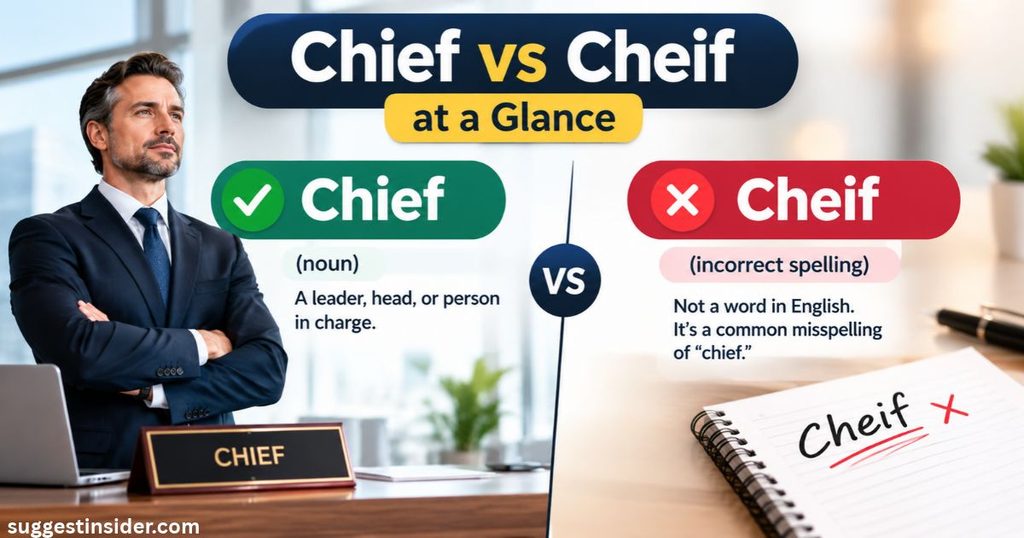
| Feature | Chief | Cheif |
| Correct spelling? | Yes | No |
| Part of speech | Noun and adjective | None (not a word) |
| Meaning | Leader, head, or main | No meaning |
| Found in dictionaries? | Yes | No |
| Plural | Chiefs | Not applicable |
| Related forms | Chiefly, chiefdom, chieftain | None |
| Safe to use in writing? | Always | Never |
The table makes the decision simple. There is only one real option, so there is nothing to weigh. You are not choosing between two valid words. You are checking that you typed the one valid word correctly.
How to Remember the Spelling
Here are a few tricks that work.
1. Use the classic rule. The old rhyme says: “I before E, except after C.” Chief has an i and an e, and the letter right before them is h, not c. So the normal order applies: i comes before e.
2. Think of its rhyming family. Chief rhymes with several “ie” words that follow the same pattern:
- brief
- thief
- grief
- relief
Say them in a row. “Chief” fits right in, while “cheif” looks odd next to them.
3. Use a memory hook. Picture a chief as the boss who catches a thief. Chief and thief rhyme, and they are spelled with the same “ief” ending. If you can spell thief, you can spell chief.
4. Know the exceptions separately. Words like receive, ceiling, and deceive flip the order because of the c before the pair. Chief has no c in front, so the exception does not apply. A few words, such as weird, seize, and neither, break the rule for other reasons. Chief is not one of them.
Chief as a Noun, an Adjective, and Part of a Title
Many writers search “chief vs cheif” because they are writing a job title or a formal document. In those cases, the word usually appears in one of three roles.
Standalone noun: “The chief approved the plan.”
Adjective before a noun: “Her chief goal is to finish by Friday.”
Part of a title: “He was promoted to chief of staff.”
Common titles and phrases that all use the correct spelling:
- Chief executive officer (CEO)
- Chief financial officer (CFO)
- Chief of staff
- Chief justice
- Chief of police
- Fire chief
- Editor in chief
- Commander in chief
- Chief complaint (a term used in medical settings for the main reason a patient seeks care)
- Chief concern
When to Capitalize Chief
Capitalization trips people up almost as often as spelling does. A reliable guide:
- Capitalize it when it comes directly before a person’s name as a title: “Chief Martinez spoke first.”
- Lowercase it when it describes a role in general: “The company hired a new chief of operations.”
- Capitalize a formal title right before a name, but lowercase it after the name: “Chief Financial Officer Dana Cole” versus “Dana Cole, our chief financial officer.”
Style guides differ on small details, so follow your workplace or publication style if one exists.
Example Sentences With Chief
Seeing the word in context helps the spelling feel natural. Here are examples from different settings.
Workplace
- The chief technology officer will present the roadmap on Monday.
- Our chief priority this quarter is customer retention.
News and public life
- The police chief announced new safety measures downtown.
- The chief justice read the court’s decision aloud.
Everyday life
- Her chief complaint about the apartment was the noise.
- The chief reason I moved here is the weather.
Plural form
- Several fire chiefs attended the training session.
Adverb form
- The recipe relies chiefly on fresh herbs.
Every one of these would look wrong with “cheif” swapped in. That is a handy test: if a word looks strange in the middle of a familiar sentence, stop and check it.
Chief and Its Look-Alikes: Chef, Chieftain, and Chiefly
Chief gets confused with other words, and not only through the “cheif” typo.
| Word | Meaning | Example |
| Chief | Leader or main | The chief of the department resigned. |
| Chef | Professional cook | The chef plated the dessert. |
| Chieftain | Leader of a clan or tribe | The chieftain led his people. |
| Chiefly | Mainly or mostly | The town is chiefly farmland. |
“Chef” is the French cousin of “chief.” In French, chef means “head” or “chief,” so a head cook was literally the “chef” of the kitchen. That shared root explains the resemblance, but the two words are not interchangeable in English. A chef cooks. A chief leads.
The plural is another trap. Some people write “chieves” because words like leaf become leaves. Chief does not do that. The plural is simply chiefs.
Is There a US vs UK Difference?
No. American and British English both spell it chief. Unlike words such as color and colour, there is no regional variant to worry about. “Cheif” is wrong everywhere, so you do not need to adjust it for your audience.
Common Mistakes and Quick Fixes
Here are the errors that show up most often, along with the fix for each.
- Writing “cheif” by accident. Fix: slow down on the middle letters, or run a quick spellcheck. Most editors catch it, but not every text box does, such as a search bar or a social media bio.
- Writing “chieves” for the plural. Fix: use “chiefs.”
- Over-capitalizing job titles. Fix: capitalize only when the title comes right before a name.
- Mixing up “chief” and “chef.” Fix: a chef cooks; a chief leads.
- Typing “cheif” in a resume or email signature. This is the costly one, because a recruiter or client may notice it before they notice your skills. Always proofread titles twice.
- Trusting autocorrect blindly. Autocorrect sometimes swaps a typo for the wrong word. Reread the sentence after it changes anything.
A quick proofreading habit helps: search your document for “cheif” with the find tool before you send or publish. It takes five seconds.
Where the Word Chief Comes From
Chief entered English from Old French, where the word appeared as chef or chief. Those forms trace back to the Latin word caput, which means “head.”That makes sense, since a chief is the head of a group.
This history explains the family resemblance between chief, chef, and even captain, which comes from the same Latin root through a different path. Thinking of “chief” as “head” can help you remember its meaning, even if it does not directly help with spelling.
Frequently Asked Questions
Is it chief or cheif?
It is chief. “Cheif” is not a recognized English word. It is a common misspelling caused by swapping the letters i and e.
Why is chief spelled with i before e?
Chief follows the standard English pattern of “i before e, except after c.” The letter before the “ie” pair is h, not c, so the normal order applies. The same pattern appears in brief, thief, and relief.
What is the plural of chief?
The plural is chiefs. Do not write “chieves.” Example: “The fire chiefs met to discuss new rules.”
Should I capitalize chief in a job title?
Capitalize it when it comes directly before a name, as in “Chief Operating Officer Maria Lopez.”
What is the difference between chief and chef?
Chief means leader or main, while chef means a professional cook. Both words come from the same French and Latin root meaning “head,” which is why they look alike, but they are used in different situations.
Conclusion
The Chief vs Cheif question has a clear answer: chief is right, and cheif is a typo. Remember the “i before e” pattern, picture the family of words like brief and thief, and proofread your titles. Once you do that a few times, the correct spelling becomes automatic.

Noah Daniel Davis is a passionate grammar and language writer who creates simple, helpful content about grammar, vocabulary, punctuation, and English writing. His goal is to make language learning easy and practical for every reader.