


You finish a thank-you email to your mentor, type “guidence,” and hit send. Then you spot the red squiggle. Too late. The Guidance vs Guidence mix-up catches careful writers all the time, because both spellings sound exactly the same out loud.
One small vowel can make a polished message look rushed. Good news: the fix takes about a minute. Here is the correct spelling, why the wrong one tempts so many people, and a trick that makes it stick.
Quick Answer
Guidance is the correct spelling. Guidence is a common misspelling and is not a word in standard English dictionaries. Guidance is a noun that means help, advice, or direction that steers someone toward a decision or goal. Always write it with “ance” at the end.
Guidance vs Guidence at a Glance
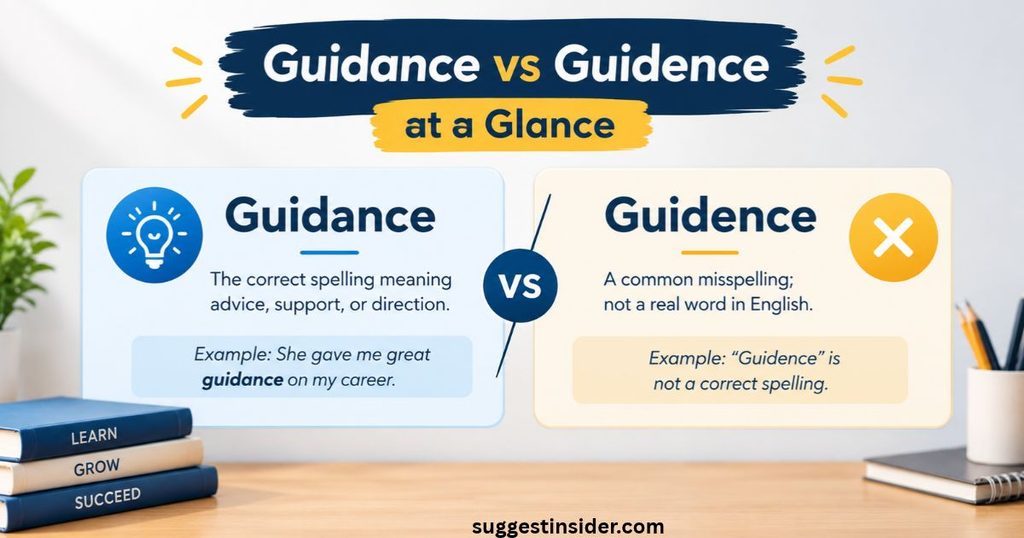
| Guidance | Guidence | |
| Correct spelling? | Yes | No |
| In dictionaries? | Yes | No |
| Part of speech | Noun | None (misspelling) |
| Pronunciation | GYE-dunss | Sounds the same, spelled wrong |
| Safe for formal writing? | Yes | Never |
| Example | She offered guidance during my first week. | Incorrect: She offered guidence during my first week. |
Why Do So Many People Write “Guidence”?
The mistake makes sense once you look at how English works. Three things push people toward the wrong vowel.
The ending is a weak sound. In spoken English, the last syllable of “guidance” is unstressed. Your mouth says a quick “dunss,” and the letter you pick, “a” or “e,” makes no audible difference.
English has two common endings that sound alike. Words like evidence, confidence, and audience use “ence.” Words like assistance, importance, and attendance use “ance.” No dependable rule tells you which is which, so many writers guess.
The “u” is silent. In “guide” and “guidance,” the “u” only keeps the “g” hard, the same way it does in guess and guitar. Silent letters are easy to forget or misplace.
Spellcheck usually catches the error. The trouble comes in places where it does not, such as handwritten notes, text boxes on some websites, and quick social media posts.
A Simple Memory Trick for the Right Spelling
Here are three ways to lock it in.
- Look for the dance. The word ends in ance, which is the first part of “dance.” Picture a dance teacher giving guidance to a nervous beginner. No guidance, no waltz.
- Start with the verb. Guidance is simply guide plus ance, with the final “e” dropped. If you can spell “guide,” you can spell “guidance.”
- Pair it with its helpful cousin. Assistance and guidance both mean support, and both end in “ance.” One cousin helps with tasks. The other helps with direction.
What Does Guidance Mean?
Guidance is help, advice, or direction that points someone toward a choice, a goal, or a path. It carries a sense of support, not control. You are not being told what to do. You are being shown the way.
The word shows up in a few main senses:
- Personal support: A mentor offers guidance on a career move.
- Official direction: A government agency publishes guidance for businesses.
- Spiritual or inner direction: Many people pray for guidance during big decisions.
- Technical control: A missile guidance system steers an object along a path.
How to say it: GYE-dunss. The first syllable rhymes with “eye,” and the “u” stays silent.
Where it comes from: The word is built from guide plus the suffix ance, which turns a verb into a noun. English borrowed guide from French, which explains why the spelling looks a little unusual.
Guidance Word Forms: Noun, Verb, Plural
One common worry is whether “guidance” can act as a verb. It cannot. Here is how the word family works.
| Word | Part of speech | Example |
| guide | Verb or noun | She will guide the tour. |
| guidance | Noun | We need your guidance. |
| guiding | Adjective or verb form | A guiding principle shaped the plan. |
| guided | Adjective or verb form | They took a guided hike. |
| guideline | Noun | Follow the guideline on page two. |
Is guidance countable? Usually not. Writers treat it as an uncountable noun, like advice or information. That means you say “some guidance” or “a piece of guidance,” but not “a guidance.”
What about “guidances”? The plural appears rarely, mostly in specialized or regulatory writing where several separate guidance documents are being discussed. In everyday writing, avoid it.
Guidance in Real Life: Examples by Setting
Seeing the word in context helps more than any definition.
At school
- Students received guidance on choosing their college majors.
- The teacher gave clear guidance before the exam.
Many schools now use the title school counselor, though guidance counselor is still widely understood in the United States.
At work
- Our manager provided guidance on the new reporting process.
- Please seek guidance from HR before making a final decision.
In personal life
- She leaned on her grandmother’s guidance after the move.
- Parents often give gentle guidance without taking over.
In official and professional settings
- The agency released new guidance for small employers.
- Under the guidance of an experienced attorney, they reviewed the contract.
Notice the pattern. In every sentence, guidance is something given, sought, or received. It works as a noun every time.
Guidance vs. Advice vs. Guidelines vs. Guide
These words overlap, which is why people mix them up. This table separates them.
| Word | What it means | Best used when |
| Guidance | Ongoing help and direction | Someone is steering you through a process |
| Advice | A specific suggestion about what to do | You want a clear opinion on one decision |
| Guidelines | Written rules or recommended steps | A document lays out how to do something |
| Guide | A person, book, or tool that leads you | You need a leader or a reference |
A quick example shows the difference. A doctor gives advice on a medicine, a hospital posts guidelines about visiting hours, a nurse offers guidance as you recover, and a pamphlet works as a guide to the whole process.
Common Phrases With Guidance
These pairings sound natural to native speakers, so they are worth learning as chunks.
- seek guidance (ask for help and direction)
- provide guidance or offer guidance
- under the guidance of (led or supervised by someone)
- career guidance and academic guidance
- parental guidance (the familiar movie rating notice)
- divine guidance or spiritual guidance
- clear guidance and practical guidance
- guidance counselor and guidance system
Common Mistakes to Avoid
Mistake 1: Writing “guidence.” This is the big one. Fix it by remembering the dance in “guidance.”
- Wrong: I appreciate your guidence.
- Right: I appreciate your guidance.
Mistake 2: Using guidance as a verb.
- Wrong: Can you guidance me through this?
- Right: Can you guide me through this?
Mistake 3: Adding “a” or making it plural in everyday writing.
- Wrong: I need a guidance.
- Right: I need guidance. (Or: I need some guidance.)
Mistake 4: Dropping the silent “u.”
- Wrong: She gave me gidance.
- Right: She gave me guidance.
Mistake 5: Mixing it up with guidelines. Guidance is the help itself. Guidelines are the written rules.
- Wrong: The guidance on the wall lists five steps.
- Right: The guidelines on the wall list five steps.
Quick Practice
Choose the correct option for each sentence. Answers follow the list.
- The coach offered helpful (guidance / guidence) before the game.
- Please (guidance / guide) the visitors to the front desk.
- The pamphlet lists the safety (guidelines / guidance) for the lab.
- I am grateful for her (guidence / guidance) this year.
- Can you give me some (guidance / guidances) on this form?
Answers: 1. guidance. 2. guide. 3. guidelines. 4. guidance. 5. guidance.
Frequently Asked Questions
Is it guidance or guidence?
Guidance is correct. “Guidence” is a misspelling that does not appear in standard dictionaries. The word ends in “ance,” just like assistance and importance.
Is guidence ever acceptable?
No. In standard English, “guidence” is always a spelling error. You might see it in a brand name or a deliberate stylistic choice, but in emails, essays, resumes, and reports, use guidance.
What is the verb form of guidance?
The verb is guide. For example: “She will guide the new hires through training.” Guidance itself is only a noun. You can say “give guidance,” but you cannot say “to guidance someone.”
Can guidance be plural?
In normal writing, no. Guidance is uncountable, so use “some guidance” or “a piece of guidance.” The plural “guidances” is rare and mostly limited to technical or regulatory contexts.
What is another word for guidance?
Good substitutes include direction, advice, support, counsel, mentoring, and instruction. Pick the one that fits the tone. Counsel sounds formal, while support feels warmer and more casual.
Conclusion
The Guidance vs Guidence question has a one word answer: guidance. Remember the dance hiding in “ance,” or think of it as guide plus ance, and the spelling will stop being a guessing game.
Next time your fingers hesitate over that vowel, trust the trick and keep typing. Your mentor will thank you for the thoughtful email, and nobody will notice a thing.

Noah Daniel Davis is a passionate grammar and language writer who creates simple, helpful content about grammar, vocabulary, punctuation, and English writing. His goal is to make language learning easy and practical for every reader.