


You are typing an email to a new client, and your fingers freeze. One S or two? The business vs bussiness question trips up confident writers every day, and a wrong guess can end up on a résumé, an invoice, or even a company sign.
Spellcheck helps only when it is switched on. The good news is that the answer is short, and once you see the logic behind it, you will stop second-guessing yourself.
Quick Answer
Business is the only correct spelling. Bussiness is a misspelling and does not exist in standard English. Spell it b-u-s-i-n-e-s-s, with one S after the U and two S’s at the very end.
Why “Bussiness” Is Never Correct
English has no word spelled “bussiness,” in American or British usage. Dictionaries do not list it as a variant, an old form, or a regional spelling. It is simply a typo that became common because the real word is tricky.
The correct word breaks into three parts: bus + i + ness.
- bus at the start, which looks like the vehicle
- i in the middle, which is the letter many people skip or double up around
- ness, a common ending that turns words into nouns (kindness, darkness, happiness)
The mistake usually happens at the seam between “bus” and “ness.” Writers hear a hard S sound and add a second S, giving “buss” plus “iness.” That is exactly where the error lives.
Business vs Bussiness at a Glance
| Feature | Business | Bussiness |
| Correct spelling | Yes | No |
| Found in dictionaries | Yes | No |
| Number of S’s | Three (one after U, two at the end) | Four |
| Part of speech | Noun (also used as an adjective in phrases) | Not a word |
| Safe for professional writing | Yes | Never |
| Example | She runs a small business. | She runs a small bussiness. (wrong) |
The simplest check is counting. Business has three S’s total. If you typed four, you added one too many.
Why So Many People Add a Second S
Misspelling this word does not mean you are bad at spelling. Three things work against you.
The sound does not match the letters. Most Americans say “BIZ-nis,” with a Z sound and almost no middle vowel. The spelling keeps a silent-feeling “i” that your ear never hears.
Double letters are slippery. Your brain knows the word ends in a double S, so your fingers sometimes repeat the pattern earlier. This is a common typing habit, not a knowledge gap.
English borrows its spelling rules from many places. The word’s spelling was set long ago and did not change when pronunciation shifted. So the spelling reflects history more than sound.
Other Common Misspellings of Business
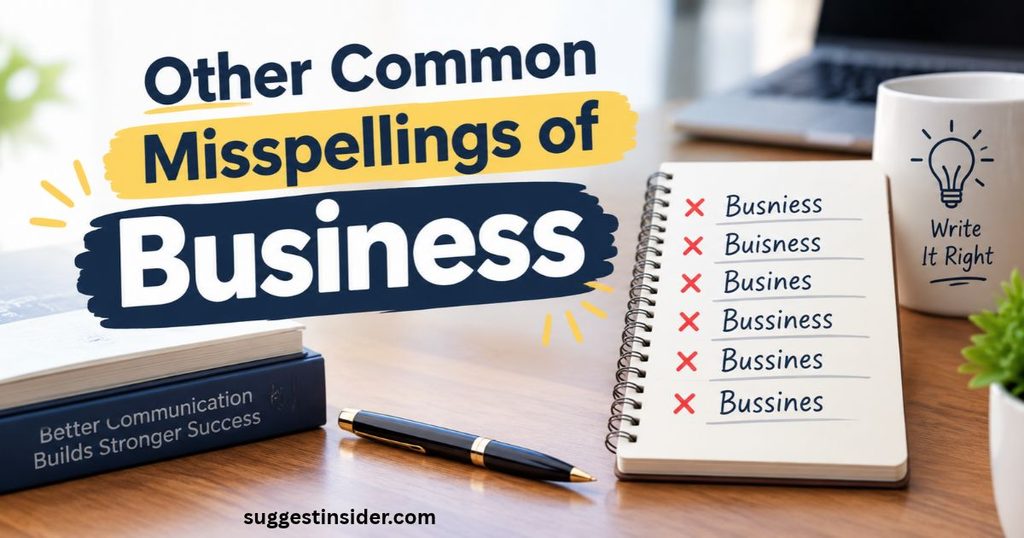
“Bussiness” is not the only trap. Here are the other versions that show up often, along with what goes wrong in each.
| Misspelling | What went wrong | Correct form |
| bussiness | Extra S in the middle | business |
| buisness | Letters I and S swapped | business |
| busness | Silent “i” dropped | business |
| bussines | Extra S in the middle, missing S at the end | business |
| busines | Missing final S | business |
| bisness | Spelled the way it sounds | business |
Notice the pattern. Every error involves either the “i” or the S’s around it. Once you lock in the structure bus-i-ness, all six mistakes disappear.
Business vs Busyness: A Real Difference
This is the one pair where two spellings are both correct, but they mean different things.
- Business refers to commerce, a company, or a matter of concern.
- Busyness means the state of being busy.
Examples:
- The busyness of the holiday season left everyone exhausted.
- Her business closes at 6 p.m. on weekdays.
The two words are related. Business comes from an older English word tied to being busy, and “busyness” is the modern spelling that keeps that link visible. If you mean “the quality of having a lot to do,” use busyness. For almost everything else, use business.
What Does “Business” Mean?
Business is a flexible noun with several everyday meanings.
- A commercial organization. My cousin started a business selling handmade candles.
- Commercial activity in general. Business has been slow this month.
- A person’s work or occupation. What line of business are you in?
- A matter or concern. That is none of your business.
- A task or issue being handled. Let’s get down to business.
It is usually uncountable when it means general activity (“business is good”) and countable when it means a company (“two businesses on the corner”). The plural is businesses, not “businesss” or “bussinesses.”
The word traces back to Old English, where a form meaning “anxiety” or “care” grew out of the word for “busy.” Over centuries the meaning shifted toward work and trade, which is why the busy connection still makes sense today.
Correct and Incorrect Sentences
Seeing the word in context helps the right spelling stick.
Correct examples
- Our family business has been open for thirty years.
- She wants to study business administration in college.
- The company is expanding its online business.
- Several businesses on Main Street closed early today.
- He has some unfinished business to take care of.
Incorrect examples
- Our family ~~bussiness~~ has been open for thirty years.
- She wants to study ~~bussiness~~ administration in college.
- The company is expanding its online ~~bussiness~~.
- Several ~~bussinesses~~ on Main Street closed early today.
- He has some unfinished ~~buisness~~ to take care of.
Every incorrect version above reads fine at a glance, which is exactly why these errors slip through. That is also why they stand out so much to readers who spot them.
Easy Ways to Remember the Spelling
You do not need a long rule. Pick one trick that clicks.
Start with “busy.” Business begins with the same four letters as busy: b-u-s-y. Swap the Y for an I and add “ness.” You get bus-i-ness.
Count the S’s. Three S’s total. One lives right after the U. Two sit at the end. If you see four, delete one.
Say it in three beats. Out loud, say “bus,” then “i,” then “ness.” Typing in three chunks stops your fingers from doubling the wrong letter.
Notice the ending. The “ness” ending appears in many English words. Business is simply busy plus a spelling adjustment, so the ending should feel familiar.
Use a quick sentence. “A busy person runs a business.” Both words share the same start, so one reminds you of the other.
Business in Professional Writing
Getting the spelling right matters most where first impressions form. A typo in a company name, a LinkedIn headline, or a proposal can make a reader doubt your attention to detail, even when your work is excellent.
A few practical points:
- Capitalization. Use a lowercase b in normal sentences. Capitalize only when it starts a sentence or is part of a formal name, such as School of Business.
- Possessives. One company takes an apostrophe plus S: the business’s policy. Several companies take the plural first: the businesses’ shared parking lot.
- Common phrases. Terms like business card, business plan, business trip, business hours, small business, and business owner all use the same single spelling.
- Domains and brand names. Check any URL, email signature, and social handle character by character. A misspelled word is easy to buy and hard to take back.
- Proofreading habit. Search your document for “bussiness” and “buisness” before sending anything important. It takes ten seconds.
Autocorrect catches most errors, but not all. Names, hashtags, and text inside images are rarely checked at all.
Frequently Asked Questions
Is it business or bussiness?
It is business. “Bussiness” is a common misspelling with an extra S in the middle and has no place in standard English.
How many S’s are in business?
Three. One S follows the U, and two S’s finish the word. The full spelling is b-u-s-i-n-e-s-s.
Is “bussiness” a British or alternate spelling?
No. Both American and British English use business. “Bussiness” is not an accepted variant in either, so you will not find it in a reliable dictionary.
Why does business sound like “biz-ness”?
Pronunciation shifted over time, and the spelling stayed the same. The middle “i” is usually reduced to almost nothing in speech, which makes the written form harder to guess by ear.
What is the plural of business?
The plural is businesses. Add “es” because the word already ends in S. Forms like “businesss” and “bussinesses” are incorrect.
Conclusion
When choosing between business vs bussiness, the decision is easy: always pick business. Remember the structure bus-i-ness, count three S’s, and think of the word “busy” as your anchor. If you mean the state of being busy, write busyness instead.
Small spelling choices carry more weight than most people expect. Take ten seconds to check this word in emails, résumés, and company names, and you will avoid a mistake that readers notice immediately.

Noah Daniel Davis is a passionate grammar and language writer who creates simple, helpful content about grammar, vocabulary, punctuation, and English writing. His goal is to make language learning easy and practical for every reader.