


You are typing a quick email about guiding a project in the right direction, and your finger hovers over the keyboard. Is it steer or stear? That tiny pause happens to a lot of writers, and a wrong guess can make a polished sentence look sloppy.
The steer vs stear question has a simple answer, and once you see why, you will not second-guess it again. Here is the correct spelling, what it means, and how to lock it in.
Quick Answer
Steer is the correct spelling. It means to guide the direction of a vehicle, boat, conversation, or plan. Stear is not a standard English word. It is almost always a misspelling of “steer,” so use “steer” every time.
What Does “Steer” Mean as a Verb?
Most of the time, “steer” is a verb. It means to control the direction something is moving, or to guide it toward a goal.
- Vehicles: She steered the car around the pothole.
- Boats: The captain steered the ship away from the rocks.
- Conversations: He steered the meeting back to the budget.
- Decisions: A good mentor can steer you toward the right career.
The idea is always the same. Someone or something is in control of the direction, and “steer” describes that act of control.
The word also works beyond physical objects. In business writing, you might steer a budget, a strategy, or a hiring plan. In everyday talk, you might steer a friend away from a bad restaurant. When the meaning is “guide, direct, or control,” “steer” fits, and the spelling never changes.
What Does “Steer” Mean as a Noun?
“Steer” also works as a noun, and this is where many people get surprised. In farming, a steer is a young male cow that has been neutered, usually raised for beef. You will see the word at county fairs and on ranches.
There is also an informal use in British English: a “steer” can mean a hint or a piece of advice, as in “Can you give me a steer on which laptop to buy?” The related phrase “bum steer” means bad advice or misleading information, and it is used in American English too.
Is “Stear” a Real Word?
No. “Stear” does not appear as a standard word in major English dictionaries. If you spot it in an essay, an email, or a social media post, it is a typo or a spelling slip.
You may occasionally see “Stear” as part of a person’s surname or a brand name. Those are proper nouns, not vocabulary words, and they have nothing to do with guiding or driving. For everyday writing, treat “stear” as an error and replace it with “steer.”
Steer vs Stear at a Glance
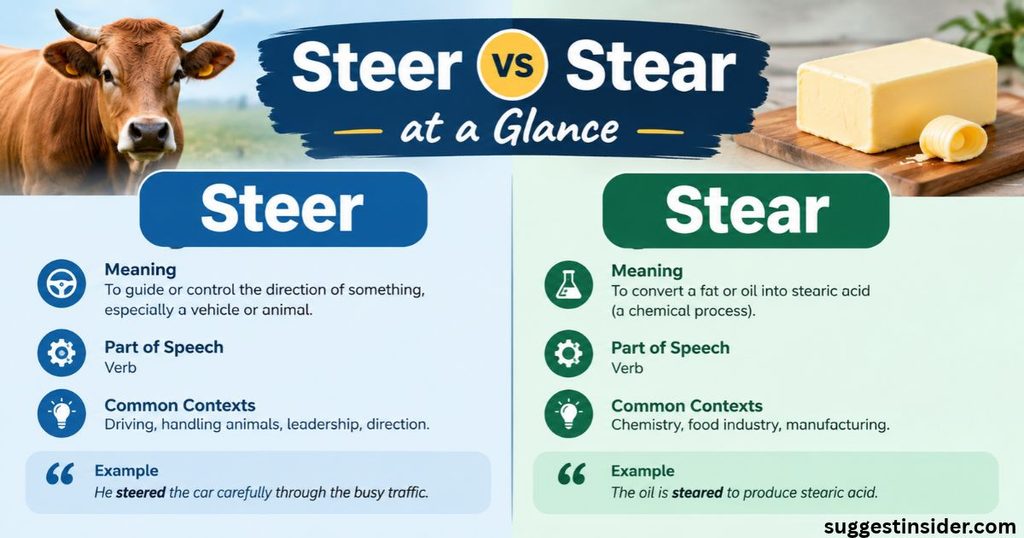
| Feature | Steer | Stear |
| Correct spelling | Yes | No |
| Part of speech | Verb and noun | None (not a word) |
| Meaning | To guide direction; a neutered young bull | No meaning in standard English |
| Pronunciation | Rhymes with “beer” and “clear” | Not applicable |
| Past tense | Steered | Not applicable |
| Use in writing | Always | Never |
Why Do People Write “Stear”?
The mistake is easy to understand. A few things push writers toward it.
English spelling is inconsistent. The “eer” sound in “steer” can be written several ways. Compare “beer,” “cheer,” and “pier.” With so many options, the brain grabs a plausible one.
Lookalike words with “ea.” Words such as “steam,” “steal,” “steak,” and “steady” all start with “stea.” Your eyes get used to that pattern, so “stear” looks almost right.
Autopilot typing. When you write fast, your fingers choose a familiar letter pair. Spellcheck usually catches it, but not always, especially in text messages and social posts.
Spellcheck gaps. Most word processors underline “stear” in red and suggest “steer.” The trouble starts in places without a safety net, such as text messages, handwritten notes, social media captions, and form fields.
A fast final read of anything you plan to publish or send is the best protection. Searching your document for “stea” can also reveal hidden slips, since that letter pair appears in many words you may have mistyped.
Spot the Mistake: Wrong and Right Sentences
Seeing the error in context helps it stick. Here are common slips and their fixes.
Incorrect:
- He tried to stear the boat toward the dock.
- Please stear clear of the wet floor.
- The coach will stear the team in a new direction.
- The stearing wheel feels loose.
Correct:
- He tried to steer the boat toward the dock.
- Please steer clear of the wet floor.
- The coach will steer the team in a new direction.
- The steering wheel feels loose.
Notice that the error often carries over into related forms. If you write “stearing” or “steared,” the root spelling is wrong, so everything built on it is wrong too.
Easy Ways to Remember the Spelling
You do not need a long rule. Pick the trick that works for you.
- Two eyes on the road. The double “ee” in steer looks like two eyes. When you steer, your eyes stay on the road, and the spelling keeps that picture.
- Rhyme it. Steer rhymes with “beer,” “cheer,” and “deer.” Say “steer clear” out loud, and the rhythm of the phrase helps the spelling come with it.
- Look for the double letter. Steer, cheer, and beer all share “ee.” If a word for guiding sounds like these, it takes “ee.”
- Think of the steering wheel. You have seen “steering wheel” printed in manuals and on dashboards. That image locks in the “ee.”
Common Phrases and Idioms with “Steer”
“Steer” shows up in plenty of everyday expressions. Knowing them helps you use the word with confidence.
- Steer clear of: to avoid something. I steer clear of spicy food before bed.
- Steer the conversation: to guide a discussion. She steered the conversation toward good news.
- Steer away from: to move toward a different option. Try to steer away from jargon in your emails.
- Steer someone wrong: to give bad advice. The review steered me wrong, and the hotel was awful.
- Bum steer: misleading advice. That tip was a bum steer.
- Steer a course: to follow a chosen path. The company steered a careful course through the recession.
More real-world examples:
- Driving: Steer gently on icy roads and avoid sudden turns.
- Sailing: The crew steered by the stars before modern navigation tools existed.
- Leadership: A calm manager can steer a stressed team through a deadline.
- Parenting: I tried to steer my kids toward healthier snacks.
- Writing: Use a clear headline to steer readers to the main point.
Steer Forms and American vs British English
“Steer” is a regular verb, so it is easy to conjugate.
| Form | Example |
| Base form | steer |
| Third person singular | steers |
| Past tense and past participle | steered |
| Present participle | steering |
There is no spelling difference between American and British English here. Both use “steer,” “steered,” and “steering.” Dictionaries from both sides of the Atlantic list the same spelling, so there is no variant to worry about.
The only regional flavor is the noun meaning “a hint,” which is more common in British usage. Related words like steerage (the cheapest section on old passenger ships) and steersman (the person who steers a boat) follow the same “ee” spelling.
Words Often Confused with “Steer”
“Stear” is not the only lookalike. These real words also cause mix-ups.
- Stere: a real but rare word. It is a metric unit for measuring stacked firewood or timber, equal to one cubic meter. It sounds like “steer,” but you will almost never need it outside of forestry or older measurement texts.
- Stir: to mix something, as in “stir the soup.” It sounds different from “steer,” though a quick typo can swap them.
- Steed: a horse, especially a spirited one. It shares “ee” but ends differently.
- Steel: the metal. Same start, very different meaning.
If you mean to guide direction, the answer is still “steer.”
Frequently Asked Questions
Is it “steer” or “stear”?
It is steer. “Stear” is a misspelling. Use “steer” for guiding a vehicle, a boat, a conversation, or a plan.
Is “stear” ever correct?
Not as an ordinary English word. It can appear as a surname or a name for a brand or place, but those are proper nouns. In regular writing, replace it with “steer.”
What is the past tense of “steer”?
The past tense is steered. Example: “She steered the project back on track.” Do not write “steared” or “stered.”
What does “steer clear” mean?
“Steer clear” means to stay away from something or someone on purpose. You steer clear of a risky shortcut, a nosy neighbor, or a topic that starts arguments.
Is a steer a bull or a cow?
A steer is a male bovine that was neutered when young, so it is neither a breeding bull nor a cow. Ranchers raise steers mainly for beef.
Final Thoughts
The steer vs stear debate has a clean winner. Steer is the only correct spelling, whether you are driving a car, guiding a team, or describing a young bull. Keep the double “ee” in mind, picture two eyes on the road, and “stear” will stop sneaking into your writing.
A quick proofread for this one word can save you from an easy, avoidable typo, and it keeps your writing looking sharp and professional.

Noah Daniel Davis is a passionate grammar and language writer who creates simple, helpful content about grammar, vocabulary, punctuation, and English writing. His goal is to make language learning easy and practical for every reader.