

You type a quick caption, and your spell-checker draws a red squiggle under a word you were sure was right. One L or two? Now you’re second-guessing yourself, and every article you’ve ever written.
The confusion around labeling vs labelling is common, and it can make a polished piece look sloppy if you mix them up. Good news: both are correct. The trick is knowing which one fits your reader, and this guide makes that choice simple.
Quick Answer
Labeling vs labelling is a spelling difference, not a meaning difference. Labeling (one L) is the standard American English spelling.
Labelling (two Ls) is the standard British English spelling, also used in most Commonwealth countries. Both are correct, so choose the one that matches your audience and stay consistent.
Why Two Spellings Exist
The split comes down to one spelling rule that American and British English apply differently.
When you add an ending like -ed, -ing, or -er to a word that finishes with a single L, the two varieties behave like this:
- British English doubles the L almost every time: label becomes labelled and labelling.
- American English doubles the final consonant only when the stress falls on the last syllable.
The word “label” is stressed on the first syllable (LAY-bul). The stress isn’t on the end, so American English leaves the L alone and gives you labeled and labeling.
American spelling was simplified in many ways during the 1800s, and Noah Webster’s dictionaries were a big part of that shift.
If you’ve ever wondered why Americans write “color” and the British write “colour,” this is the same story. The extra L in labelling is the British equivalent of the extra U.
Labeling vs Labelling at a Glance
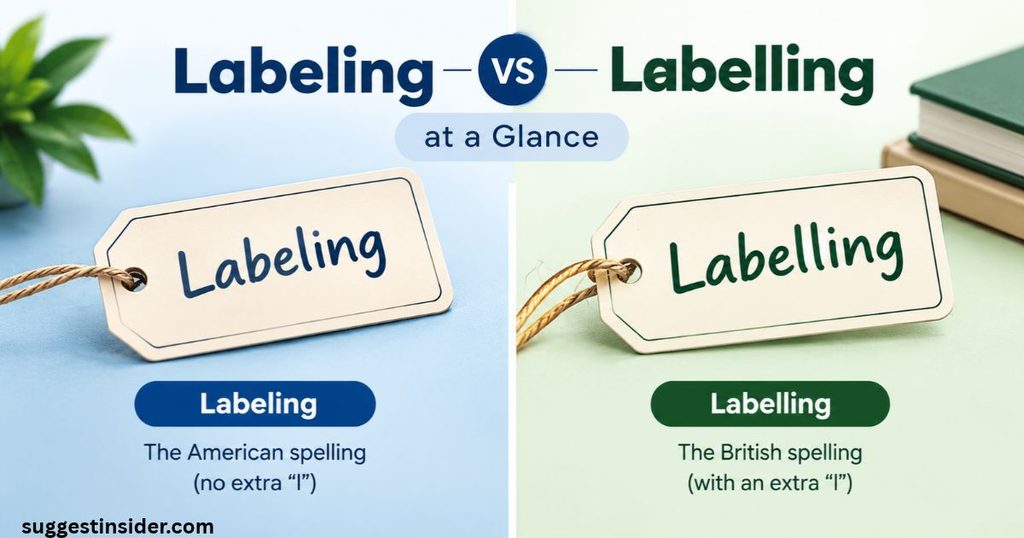
| Feature | Labeling | Labelling |
| Number of Ls | One | Two |
| Main region | United States | UK, Ireland, Australia, New Zealand, South Africa, India, and generally Canada |
| Past tense | Labeled | Labelled |
| Person who labels | Labeler | Labeller |
| Meaning | Identical | Identical |
| Pronunciation | LAY-buh-ling | LAY-buh-ling |
Notice the pronunciation row. You can’t hear the difference, which is exactly why this one trips people up in writing.
Which Spelling Should You Use?
Match the spelling to the people who will read your work. Here is a practical way to decide.
- US readers: Use labeling. This applies to American websites, US business documents, and school work in the United States.
- UK, Irish, Australian, New Zealand, South African, or Indian readers: Use labelling.
- Canadian readers: Canadian English usually follows the British pattern for this word, so labelling is the safer pick, though you will see both.
- Global readers: Choose the spelling your largest group of readers uses and apply it everywhere.
- Following a style guide: Do what the guide says. Many US style guides, including AP and Chicago, use labeling, while UK publishers typically follow labelling.
If your teacher, editor, or client names a preferred dictionary, that decision beats any general rule.
Do the Two Spellings Mean Different Things?
No. Labeling and labelling mean the same thing in every context. Both come from the verb “to label,” and both work as a verb form (the -ing form) or as a noun.
As a verb form: the action of attaching or assigning a label.
- She is labeling every box before the move. (US)
- He is labelling the jars with the date. (UK)
As a noun: the labels on something, or the system of information printed on them.
- The labeling on this bottle lists every ingredient. (US)
- The labelling on the packet is hard to read. (UK)
In a figurative sense: putting someone or something into a category, often unfairly.
- Stop labeling him as the quiet one. (US)
- Stop labelling her as difficult. (UK)
The meaning never changes. Only the spelling does.
The Whole Word Family
Once you pick a side, the rest of the family follows. Here is how the common forms line up.
| Base word | American spelling | British spelling |
| label (verb) | labeled, labeling | labelled, labelling |
| labeler | labeler | labeller |
| mislabel | mislabeled, mislabeling | mislabelled, mislabelling |
| relabel | relabeled, relabeling | relabelled, relabelling |
| label (noun) | label, labels | label, labels |
The base word “label” never changes. It only matters when you add an ending.
Other words follow the same pattern, which makes the rule easier to remember:
- travel: traveling (US), travelling (UK)
- model: modeling (US), modelling (UK)
- cancel: canceling (US), cancelling (UK)
- signal: signaling (US), signalling (UK)
There are exceptions where both varieties double the L, such as controlled and patrolled. In those words the stress lands on the final syllable, so American English doubles the consonant too.
Where You’ll See Each Spelling in Real Life
Spelling shows up differently depending on the field, and the same topic can look different on each side of the Atlantic.
- Food and packaging: In the US, you read about food labeling and nutrition labeling. In the UK, the same topic is called food labelling.
- Data and technology: Teams in the US often talk about data labeling for machine learning projects. A British team would write data labelling.
- Social science: The idea that society’s tags shape a person’s behavior is called labeling theory in American texts and labelling theory in many British ones.
- Everyday life: Think of moving boxes, spice jars, school supplies, and filing folders. The spelling depends on where the writer lives.
Official names are a special case. If a UK law, product line, or organization uses “labelling” in its title, keep it that way even when the rest of your text uses American spelling. The same goes in reverse.
Example Sentences
Seeing both forms in context makes the pattern easy to spot.
American English (labeling, labeled)
- The warehouse team is labeling each shelf by aisle.
- She labeled the leftovers so nobody ate her lasagna.
- Clear labeling helps customers compare products quickly.
- The app handles photo labeling automatically.
British English (labelling, labelled)
- The warehouse team is labelling each shelf by aisle.
- She labelled the leftovers so nobody ate her lasagne.
- Clear labelling helps customers compare products quickly.
- The app handles photo labelling automatically.
Same sentences, same meaning, different region. Whichever set you use, apply it all the way through.
Common Mistakes and Quick Fixes
Mistake 1: Treating one spelling as a typo. Neither is an error. A red underline only means your spell-checker is set to the other variety.
Mistake 2: Giving the spellings different meanings. Some writers assume labelling is “more formal” or has a special sense. It doesn’t. It’s purely regional.
Mistake 3: Mixing forms in one sentence. Writing “labeling” in one line and “labelled” in the next is inconsistent. In American English, both of those would be single-L: labeling and labeled. In British English, both would have two Ls.
Mistake 4: Switching styles midway through a document. Readers notice when an article starts with “color” and “labeling” and ends with “colour” and “labelling.” Decide first, then stick with it.
Mistake 5: Changing a direct quote or official title. If a source wrote “labelling,” keep it that way inside quotation marks, even in an American article. The same applies to names of laws, products, or organizations.
Mistake 6: Typing “lable.” This one is a genuine misspelling. The word is label, with the A and the B in that order.
How to Stop Spell-Check From Fighting You
Most of the confusion starts with a language setting, not with you.
- Microsoft Word: Go to Review, then Language, then Set Proofing Language, and pick English (US) or English (UK).
- Google Docs: Open the File menu, choose Language, and select your English variety.
- Phones and browsers: Check the keyboard and browser language settings, since autocorrect often follows them.
If you edit for clients in different regions, change the setting per document. That alone prevents most mix-ups. Before you publish, do one quick search for “ll” in words like labelled, travelled, and cancelled to make sure nothing slipped through.
An Easy Way to Remember Which Is Which
Think of the colour and color pair. British English tends to hold on to extra letters, and American English trims them. So the extra L in labelling is the British version, and the single L in labeling is the American one.
Another quick check: if you’re writing for people in the US, ask yourself whether you’d write “traveling.” If yes, write labeling. If you’d write “travelling,” write labelling.
Frequently Asked Questions
What is the difference between labeling and labelling?
There is no difference in meaning. Labeling uses one L and is the American spelling. Labelling uses two Ls and is the British spelling.
Is labeling or labelling correct?
Both are correct. Which one is right depends on the variety of English you are writing in. Use labeling for American English and labelling for British English.
Are labeling and labelling pronounced differently?
No. Both are pronounced the same way, roughly LAY-buh-ling. The difference only appears in writing.
Which spelling should I use for a US audience?
Use labeling, along with labeled and labeler. Keep your other word choices American too, such as color, center, and traveling, so the whole piece feels consistent.
Which spelling is better for an international audience?
Neither is better in general. Look at where most of your readers live and pick that variety. If your readers are mixed, follow your style guide or your main market, then stay consistent from start to finish.
Conclusion
Labeling vs labelling is really a question of audience, not correctness. Use labeling for American readers and labelling for British and most Commonwealth readers.
Keep the whole word family matched, set your spell-checker to the right language, and leave quotes and official titles exactly as they appear. Do that, and the extra L will never trip you up again.

Noah Daniel Davis is a passionate grammar and language writer who creates simple, helpful content about grammar, vocabulary, punctuation, and English writing. His goal is to make language learning easy and practical for every reader.